

DEX venue differences explained for automated trading

Most traders assume all perpetual DEXs operate the same way, but venue architecture differences create measurable impacts on execution quality, slippage, and profitability. Order book platforms like Hyperliquid deliver sub-1ms matching speeds, while AMM-based venues offer zero slippage up to pool limits but face oracle lag during volatility. Understanding these structural distinctions isn’t academic, it’s the foundation for building resilient automated trading strategies that exploit venue-specific advantages. This guide breaks down the technical realities that separate winning bots from mediocre ones.
Table of Contents
- Key takeaways
- Understanding decentralized exchange venue architectures
- Latency and fee structures: critical factors for automated trading
- Risk nuances and execution edge cases in perpetual DEX trading
- Practical application: choosing and integrating DEX venues for your automated strategies
- Enhance your automated trading with Mithril Money
- Frequently asked questions
Key Takeaways
| Point | Details |
|---|---|
| Order book precision | Order book DEXs enable precise limit orders but thin liquidity can create slippage. |
| AMMs zero slippage | AMMs provide zero slippage up to pool depth but suffer oracle lag during rapid price moves. |
| Latency drives strategies | Latency varies widely across venues, shaping timing for high frequency trading and liquidations. |
| Fee structure matters | Maker versus taker fees directly impact net profitability, influencing strategy choice. |
Understanding decentralized exchange venue architectures
Perpetual DEX venues split into two fundamental categories: order book platforms and automated market makers. Each architecture creates distinct execution environments with direct consequences for your trading strategies.
Order book DEXs enable limit orders and precise price discovery through visible bid and ask queues. You place orders at specific prices, and the matching engine pairs buyers with sellers. This model mirrors centralized exchanges but introduces blockchain latency and liquidity fragmentation. Thin order books on less popular pairs create slippage when your bot tries to execute larger positions. The advantage? Exact price control and the ability to provide liquidity as a maker, earning rebates while your bot waits for fills.
AMMs flip this model entirely. Instead of matching orders, they use liquidity pools where traders swap against pooled assets. Pricing follows mathematical curves, typically constant product formulas. You get zero slippage up to pool size but face oracle lag since prices update based on external feeds rather than real-time order flow. For liquidity providers, impermanent loss becomes a critical concern, directly affecting available depth and spread behavior your bots must navigate.
Key architectural distinctions:
- Order books require active liquidity provision, creating maker/taker dynamics that sophisticated bots exploit
- AMMs provide passive liquidity with predictable execution costs but oracle-dependent pricing
- Latency profiles differ fundamentally, with order books facing matching delays and AMMs facing oracle update delays
- Slippage behaves opposite: order books show linear degradation with size, AMMs show exponential curves beyond pool limits
For automated trading strategies, these differences determine whether you can reliably capture funding arbitrage, execute market making with tight spreads, or scale directional positions without price impact. Order book venues suit high-frequency strategies where milliseconds matter. AMM venues excel for larger directional bets where you need guaranteed execution without worrying about book depth.
Latency and fee structures: critical factors for automated trading
Execution speed and transaction costs separate profitable automated strategies from break-even operations. Venue selection based on these metrics isn’t optional.

Hyperliquid delivers approximately 200ms block time with sub-1ms matching, making it the performance leader for latency-sensitive strategies. dYdX operates around 1 second latency, while GMX ranges from 250ms to 1 second depending on network conditions. Solana-based venues like Drift and Jupiter typically show 400ms latency, but Jito bundles can compress this to approximately 50ms for algorithmic traders willing to pay priority fees. These differences directly impact liquidation sniping, funding arbitrage timing, and scalping profitability.
| Venue | Block Time | Matching Speed | Maker Fee | Taker Fee |
|---|---|---|---|---|
| Hyperliquid | ~200ms | <1ms | 0.01% | 0.035% |
| dYdX | ~1s | ~1s | 0.02% | 0.05% |
| GMX | 250ms-1s | Variable | 0.04% | 0.07% |
| Drift (Solana) | ~400ms | ~50ms with Jito | 0.02% | 0.06% |
Fee structures show maker rates between 0.01-0.02% and taker rates between 0.035-0.06% across major venues. Hyperliquid offers the lowest taker fee at 0.035% with maker rebates that improve economics for liquidity-providing strategies. GMX charges 0.04-0.07% but compensates with zero slippage on major pairs due to its pool-based model. For high-frequency bots executing hundreds of trades daily, a 0.02% fee difference compounds into substantial profit erosion.
Why latency and fees critically affect strategy profitability:
- Liquidation bots require sub-second execution to front-run competitors and capture liquidation premiums
- Funding arbitrage windows close within seconds as rates update, demanding fast cross-venue execution
- Market making spreads must exceed combined maker/taker fees plus expected adverse selection costs
- Scalping strategies need tight spreads and low taker fees to overcome the bid-ask capture requirement
Pro Tip: Calculate your break-even fee threshold by dividing expected spread capture by trade frequency. If your bot averages 0.08% per trade but pays 0.06% in fees, you’re only netting 0.02% before slippage and adverse selection. Venues with maker rebates can flip this equation, paying you to provide liquidity while your strategy captures spreads. Evaluate fee design implications against your specific strategy profile before committing capital.
Zero slippage on major pairs at venues like GMX offsets higher fees for directional strategies. If you’re executing a $100,000 position, saving 0.5% in slippage ($500) easily justifies paying an extra 0.03% in fees ($30). The math reverses for high-frequency strategies making 50+ trades daily, where cumulative fees dominate total costs.
Risk nuances and execution edge cases in perpetual DEX trading
Venue architecture introduces risk scenarios that don’t exist on centralized exchanges. Your bots must account for these structural limitations or face unexpected losses.
Slippage on thin order books becomes severe for illiquid pairs. A $10,000 order on a pair with $50,000 daily volume might experience 0.05-0.20% slippage as your bot walks through multiple price levels. This compounds when closing positions during volatility, potentially erasing entire trade profits. Order book depth directly determines your maximum position size before execution quality degrades.
AMM oracle deviation reaches 1-3 seconds during volatility, creating price accuracy gaps when markets move fast. Your bot might execute at a stale price while the true market has shifted 0.5-1% away. This oracle lag particularly impacts stop losses and liquidation triggers, which fire based on delayed price feeds rather than real-time market conditions.
MEV (maximal extractable value) risk concentrates in AMM venues where sandwich attacks exploit pending transactions. Searchers see your large swap in the mempool, front-run it to move the price against you, then back-run to capture the spread. Order book DEXs with private mempools or batch auctions reduce this attack surface. MEV extraction in AMMs can cost 0.1-0.5% on sizable trades.
Liquidation timing advantages emerge on custom layer 1 blockchains like Hyperliquid. Faster block times and deterministic ordering let liquidation bots execute before competitors on slower chains. The same strategy might capture 2% liquidation premiums on Hyperliquid but only 0.5% on a general-purpose chain with higher latency and more competition.
Key edge case risks affecting automated strategies:
- Thin order books create cascading slippage during rapid position changes, especially on long-tail pairs
- Oracle delays cause liquidations to trigger at incorrect prices, creating unfair losses or missed opportunities
- MEV searchers extract value from predictable AMM trades, requiring private transaction submission
- Cross-margin complexity across venues creates liquidation contagion when one position moves against you
“Edge cases reveal themselves during volatility. A bot that works perfectly in calm markets can hemorrhage capital when liquidity evaporates and oracle feeds lag behind reality. Stress test your strategies against 10% moves in under 60 seconds.”
Pro Tip: Monitor multiple venues simultaneously to detect price divergence and liquidity shifts before they impact your positions. If one venue’s oracle lags by 2 seconds while another updates in real time, that information asymmetry becomes tradable alpha. Build fallback execution paths so your automated strategies can route orders to the venue with best current conditions rather than being locked into a single platform.
Custom layer 1 blockchains sacrifice some decentralization for execution speed critical in high-frequency and liquidation strategies. This trade-off suits professional traders prioritizing performance over maximum censorship resistance. AMMs better serve large directional positions where you need guaranteed execution without worrying about order book depth or maker queue position.
Practical application: choosing and integrating DEX venues for your automated strategies
Translating venue knowledge into execution requires systematic evaluation and integration planning. Here’s how to match venues to your strategy requirements.
Start by mapping your strategy’s critical requirements against venue capabilities. High-frequency strategies demand sub-200ms latency, making Hyperliquid or Solana venues mandatory. Market making strategies need tight spreads and maker rebates, favoring order book platforms with deep liquidity. Directional strategies prioritize execution certainty and slippage minimization, where AMMs with large pools excel.
| Criteria | Order Book (Hyperliquid) | AMM (GMX) |
|---|---|---|
| Latency | Sub-1ms matching | 250ms-1s |
| Limit order support | Full limit/stop orders | Market orders only |
| Slippage predictability | Variable by depth | Zero up to pool size |
| Best for | HFT, market making, precise entries | Large directional, simplified execution |
| API complexity | Advanced order types | Simple swap interface |
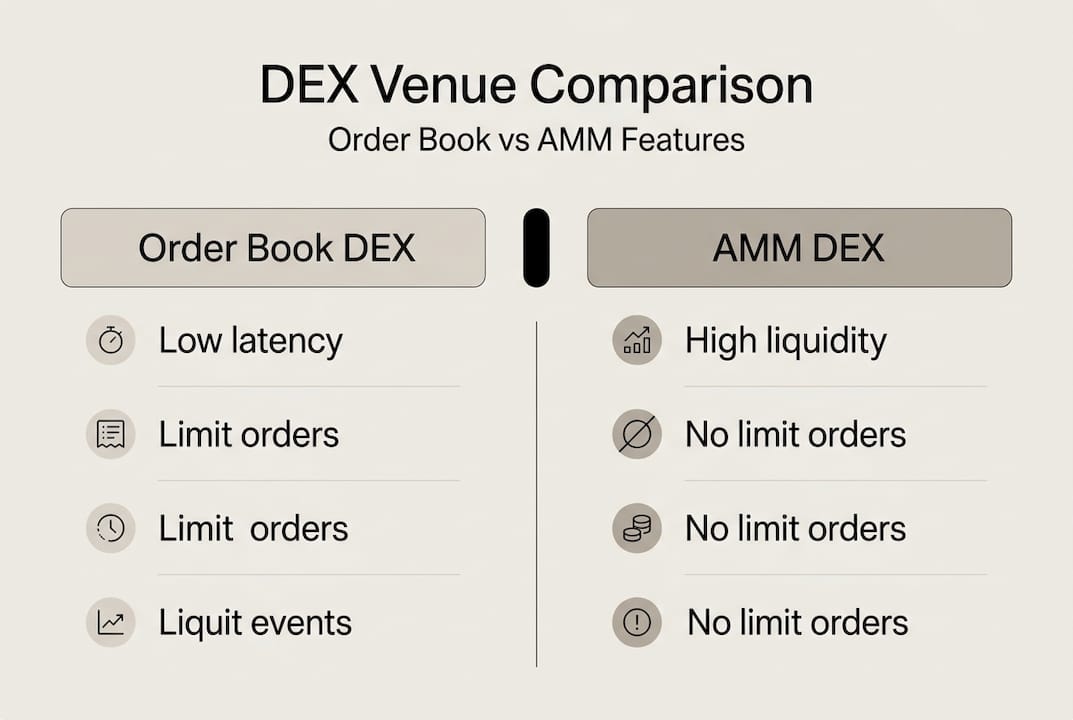
Prefer order book DEXs like Hyperliquid for low-latency APIs and limit order functionality in your bots. The ability to place resting orders and earn maker rebates fundamentally changes strategy economics. Use aggregators for cross-venue arbitrage opportunities, but watch cross-margin risks where a losing position on one venue can trigger liquidations across your entire portfolio.
Combining venue types diversifies execution and reduces single-point failures. Run market making bots on order book venues while executing directional positions on AMMs. This separation isolates strategy-specific risks and optimizes each approach for its ideal environment. A funding arbitrage strategy might long on an AMM for guaranteed execution while shorting on an order book for tighter spread capture.
Integrating venue data feeds and APIs:
- Establish WebSocket connections to real-time order book or pool state data for each venue
- Normalize data formats across venues since each uses different schemas and update frequencies
- Implement venue-specific order routing logic that accounts for each platform’s execution quirks
- Build unified position tracking that aggregates exposure across all venues in real time
- Create alerting for cross-venue price divergence, liquidity shifts, and execution quality degradation
- Test failover logic so your bot can switch venues if primary execution path degrades
Expert nuance reveals custom L1s like Hyperliquid sacrifice decentralization for speed vital in HFT and liquidation sniping. This trade-off makes sense for professional strategies where execution quality directly determines profitability. AMMs better serve large directional bets without slippage concerns.
Informed trade-offs between decentralization and execution speed depend on your strategy goals. Maximum censorship resistance matters less if you’re running market-neutral strategies with tight risk controls. Conversely, long-term directional positions might prioritize decentralization since execution timing matters less than platform permanence.
Venue selection isn’t static. Market conditions shift, liquidity migrates, and new platforms launch with better technology. Review your venue mix quarterly, analyzing execution quality metrics like fill rates, slippage, and latency percentiles. Your automated trading strategy should adapt as the competitive landscape evolves. Track performance across venues using the leaderboard to identify which platforms deliver best results for your specific approach.
Enhance your automated trading with Mithril Money
Understanding venue differences creates the foundation, but execution separates knowledge from profit. Mithril Money provides the automation layer that turns venue insights into live trading strategies without requiring you to build custom infrastructure.
Our platform handles the complexity of multi-venue execution, letting you focus on strategy logic while we manage API connections, order routing, and risk controls. The points estimator helps you model fee impacts and optimize venue selection before deploying capital. Comprehensive strategy guides walk through integration patterns for funding arbitrage, market making, and directional strategies across different venue types.
Mithril’s non-custodial design means your funds stay on the exchange while our bots execute through API access. You maintain complete control while gaining professional-grade automation, cross-venue analytics, and AI-assisted strategy optimization. Whether you’re running high-frequency liquidation bots on Hyperliquid or directional positions on GMX, Mithril adapts execution logic to each venue’s specific characteristics.
Frequently asked questions
What is the main difference between order book DEXs and AMMs?
Order book DEXs match bids and asks through visible queues, enabling limit orders with precise price control. AMMs use liquidity pools where traders swap against pooled assets based on algorithmic pricing curves. Order books offer granular execution control but require monitoring depth and spread. AMMs provide simpler access with predictable execution up to pool size but involve impermanent loss risks for liquidity providers and oracle lag during volatility.
Which DEX venues offer the lowest latency for automated trading?
Hyperliquid leads with sub-1ms matching and approximately 200ms block time, ideal for high-speed strategies like liquidation sniping and scalping. Solana DEXs improve with Jito bundles to approximately 50ms latency for algorithmic trading willing to pay priority fees. Other venues like dYdX and GMX operate around 1 second or higher, making them less suitable for latency-sensitive strategies but adequate for market making and directional trading.
How do fees on perpetual DEXs impact automated trading profitability?
Maker fees typically range 0.01-0.02% while taker fees span 0.035-0.06% across major venues, directly affecting net returns per trade. Hyperliquid offers the lowest taker fee at 0.035% with maker rebates that can flip economics positive for liquidity-providing strategies. High fees erode profitability for high-frequency bots executing dozens of trades daily, making fee-optimized venue selection essential. Calculate your break-even threshold by comparing expected spread capture against cumulative fee costs.
Can I use multiple DEX venues simultaneously to improve my automated trading?
Yes, multi-venue strategies enable arbitrage opportunities and execution diversification that single-venue approaches miss. Aggregators facilitate cross-venue execution but introduce cross-margin complexity where losses on one platform can trigger liquidations across your entire portfolio. Careful risk controls, unified position tracking, and venue-specific execution logic become critical. Run different strategy types on optimal venues, like market making on order books while executing directional positions on AMMs, to maximize each platform’s strengths while isolating risks through proper automated strategies.