

Trading logic automation guide for perpetual DEX traders
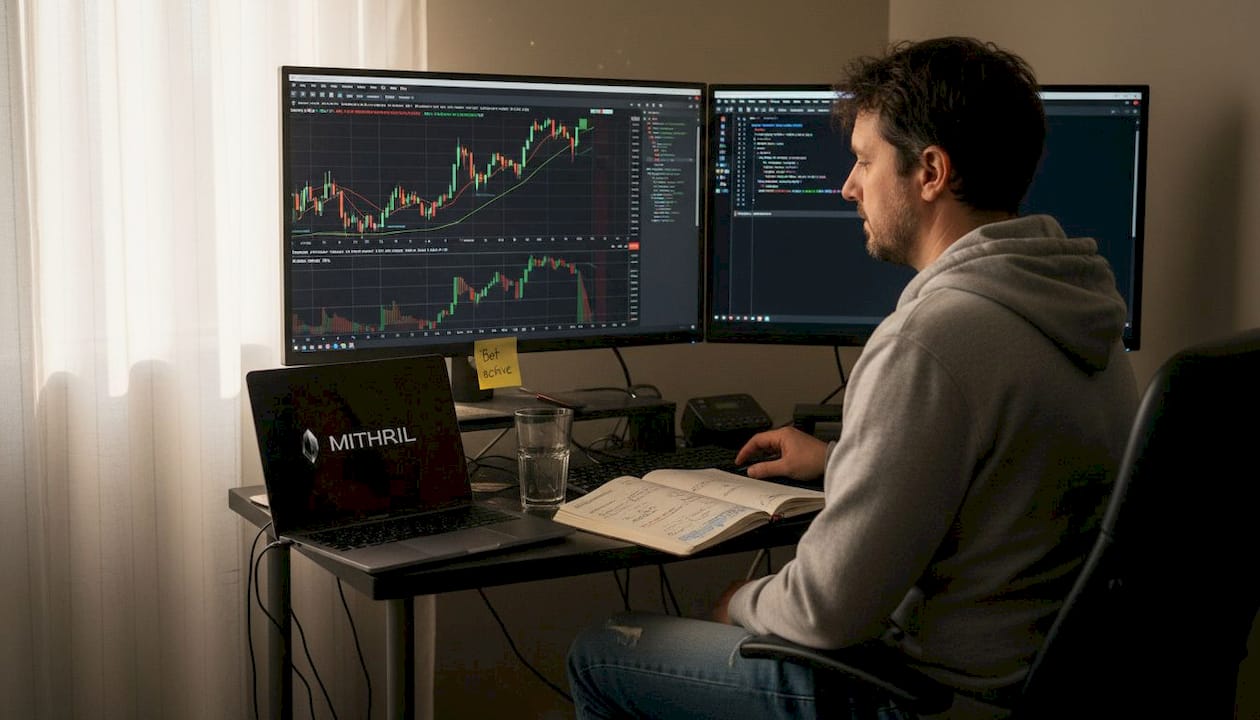
Many traders assume automating strategies on perpetual DEXs demands custom infrastructure, extensive coding knowledge, and months of engineering work. This misconception keeps profitable execution out of reach for skilled strategists who lack technical resources. The reality is far simpler. Modern platforms now handle the complexity behind the scenes, letting you focus on strategy while automation manages execution, risk controls, and iteration. This guide walks you through core automation concepts, practical software options, deployment best practices, and risk management frameworks designed specifically for perpetual DEX trading.
Table of Contents
- Key takeaways
- Understanding trading logic automation on perpetual DEXs
- Core software frameworks and tools for trading automation
- Best practices for deploying and optimizing trading logic automation
- Comparing manual versus automated execution: advantages and trade-offs
- Explore Mithril Money’s automated trading solutions
- Frequently asked questions
Key Takeaways
| Point | Details |
|---|---|
| Speed and consistency gains | Trading logic automation on perpetual DEXs runs predefined rules with real time market data to execute orders faster and with fewer human errors. |
| Reduced infrastructure needs | Modern platforms handle API connections order management and execution logic so traders configure strategies without building custom infrastructure. |
| Risk management remains critical | Automation does not remove risk concerns; you still need risk controls and strategy optimization frameworks for perpetual DEX trading. |
| Volume based bots | Mithril Money offers volume based automated bots that deploy in seconds with full non custodial execution. |
| Pilot before scaling | Begin with a single well defined strategy on one trading pair to master the automation workflow before expanding to multiple markets. |
Understanding trading logic automation on perpetual DEXs
Trading logic automation means converting your strategy rules into executable code that runs continuously without manual intervention. On perpetual DEXs, this involves connecting to exchange APIs, monitoring market conditions in real time, and placing orders based on predefined logic. Trading logic automation enhances execution speed and strategy precision on decentralized perpetual exchanges.
Perpetual DEXs present unique automation requirements compared to centralized venues. Funding rates fluctuate rapidly, liquidity pools shift constantly, and on-chain settlement introduces latency considerations absent from traditional exchanges. Your automation must account for gas fees, block confirmation times, and the non-custodial nature of decentralized trading.
Automation delivers three core benefits. First, execution speed increases dramatically. Bots react to price movements in milliseconds, capturing opportunities before manual traders can click. Second, consistency improves. Human emotions and fatigue disappear when rules execute identically every time. Third, you can run multiple strategies simultaneously across different pairs and venues without splitting attention.
Without automation, traders face constant latency issues. Manual order placement takes seconds, during which prices move and opportunities vanish. Reaction time to funding rate changes or volatility spikes remains slow. Execution risk compounds as you juggle multiple positions, leading to missed hedges or poorly timed exits.
Pro Tip: Start with a single, well-defined strategy on one trading pair before scaling to multiple markets. Master the automation workflow with manageable scope, then expand once you understand performance patterns and risk characteristics.
Core software frameworks and tools for trading automation
Several platforms now provide ready-to-use automation infrastructure for perpetual DEX traders. These tools handle the technical complexity of API connections, order management, and execution logic, letting you configure strategies through interfaces rather than writing code from scratch.
Leading software toolkits enable traders to automate logic without extensive technical overhead, integrating with perpetual DEX protocols. Mithril Money offers volume-based automated bots that deploy in seconds with full non-custodial execution. Hummingbot provides open-source market making and arbitrage strategies with extensive customization options. 3Commas supports grid trading and DCA bots across multiple exchanges, though primarily centralized venues.
| Platform | Key Strength | Complexity Level | Integration Scope |
|---|---|---|---|
| Mithril Money | Non-custodial perp DEX automation with AI-assisted optimization | Low | Multiple perp DEXs with venue-specific strategies |
| Hummingbot | Open-source flexibility and community strategies | Medium to High | Broad exchange support with manual configuration |
| 3Commas | User-friendly interface for grid and DCA strategies | Low to Medium | Primarily centralized exchanges |
| Custom Scripts | Complete control over execution logic | High | Requires full infrastructure setup |
These platforms reduce infrastructure needs significantly. Instead of building order management systems, handling WebSocket connections, and managing state across multiple exchanges, you configure parameters and deploy. Execution engines run on platform infrastructure, removing server maintenance and uptime concerns.
Volume-based automated bots represent a particularly effective approach for perpetual DEX trading. These bots adjust position sizes and order frequencies based on market volume patterns, capturing liquidity when available and reducing exposure during thin periods. This dynamic sizing prevents overtrading in illiquid conditions while maximizing capture during high-volume windows.
Pro Tip: Evaluate automation tools based on execution latency metrics and built-in risk controls before committing capital. Request performance data showing actual fill rates, slippage statistics, and downtime history. Platforms with sub-second execution and automatic position limits provide the best foundation for consistent results.
Best practices for deploying and optimizing trading logic automation
Successful automation deployment follows a structured testing and launch process. Start by paper trading your strategy for at least two weeks, tracking hypothetical performance against live market data. This reveals edge cases and parameter sensitivities without risking capital. Once paper results meet expectations, deploy with minimum position sizes, gradually increasing allocation as real performance validates your logic.
Monitor these metrics continuously for ongoing strategy evaluation:
- Execution latency: Time between signal generation and order fill
- Fill rate: Percentage of intended orders that complete successfully
- Slippage: Difference between expected and actual execution prices
- Win rate: Proportion of profitable trades to total trades
- Maximum drawdown: Largest peak-to-trough decline in account value
- Sharpe ratio: Risk-adjusted return measuring consistency
Perpetual DEXs introduce specific risk factors requiring targeted mitigation. Funding rate volatility can erode profits rapidly if positions remain open through unfavorable periods. Set automatic position closures when funding exceeds threshold levels. Liquidity fragmentation across venues means your bot might execute on one DEX while better prices exist elsewhere. Implement cross-venue price checks before finalizing orders.

Gas fee spikes on Ethereum-based DEXs can turn profitable trades into losses instantly. Build fee monitoring into your logic, pausing execution when costs exceed acceptable percentages of trade size. Smart contract risk remains present, so diversify across multiple protocols rather than concentrating exposure on a single venue.
Careful optimization of automated trading logic significantly enhances performance and helps mitigate execution risks. Make incremental improvements to one parameter at a time, measuring impact before adjusting additional variables. This systematic approach isolates what actually drives performance improvements versus random variance.
Version control becomes essential as strategies evolve. Save configuration snapshots before each change, documenting the reasoning and expected outcome. When performance degrades, you can quickly revert to previous stable versions rather than troubleshooting blind.
“Iterative testing with small capital allocations reveals strategy weaknesses faster than theoretical analysis. Risk awareness must precede optimization, traders who automate without understanding failure modes inevitably face unexpected losses.”
Comparing manual versus automated execution: advantages and trade-offs
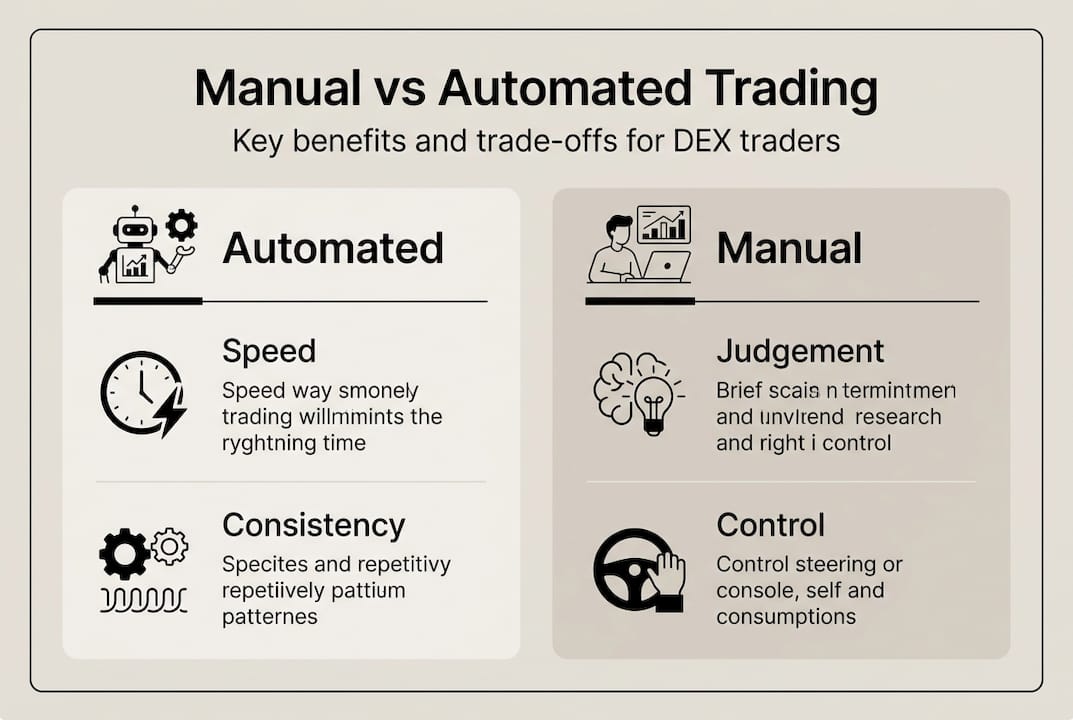
Automated trading logic offers superior consistency and faster execution, though manual oversight remains important for nuanced decisions. Understanding when each approach excels helps you allocate resources effectively.
Automated execution dominates in speed and accuracy. Bots place orders in milliseconds, capturing price levels impossible for manual traders. Consistency remains perfect, strategies execute identically regardless of time, fatigue, or emotional state. You can run strategies 24/7 across multiple pairs simultaneously, maximizing opportunity capture without attention splitting.
Manual execution retains advantages in specific scenarios. Novel market conditions outside historical patterns may require judgment calls automation cannot make. Black swan events demand rapid strategy pivots that pre-programmed logic might miss. Complex multi-leg trades involving timing across correlated assets sometimes benefit from human coordination.
| Factor | Automated Execution | Manual Execution |
|---|---|---|
| Speed | Millisecond reaction times | Seconds to minutes |
| Consistency | Identical execution every time | Varies with trader state |
| Scalability | Multiple strategies and pairs simultaneously | Limited by attention |
| Adaptability | Requires reprogramming for new conditions | Immediate judgment adjustments |
| Emotional Control | Complete elimination | Requires discipline |
| Nuanced Decisions | Limited to programmed scenarios | Full contextual analysis |
The optimal approach combines both methods strategically. Use automation for high-frequency, rule-based execution where speed and consistency matter most. Reserve manual intervention for strategy adjustments, risk limit changes, and responses to unprecedented market events.
Automation complements manual strategy development beautifully. You design and backtest strategies manually, then deploy automation to execute them flawlessly. As live performance data accumulates, you analyze results manually to identify improvements, then update automated parameters accordingly. This cycle leverages human creativity for strategy design while using machines for tireless execution.
Risk management represents another area where automation excels. Stop losses trigger instantly without hesitation or second-guessing. Position size limits enforce themselves automatically, preventing emotional overtrading during winning or losing streaks. Correlation monitoring across positions happens continuously, alerting you to concentration risks before they materialize.
Explore Mithril Money’s automated trading solutions
If you’re ready to implement efficient trading automation without building infrastructure, Mithril Money provides the execution layer between your strategy ideas and live perpetual DEX trading. The platform handles strategy logic, automation, risk management, and iteration while you retain full control of funds on the exchange.
Mithril deploys automated bots in seconds through API connections to your exchange account. Strategies include built-in risk controls, refresh logic, and safety mechanisms that execute consistently without manual monitoring. The platform supports delta-neutral funding arbitrage, market making with dynamic spreads, momentum scalping, grid trading, and directional setups across multiple perpetual DEXs.
Explore volume automated bot tools to estimate potential returns and points accumulation based on your trading parameters. Check automated trading exchange offers to discover venue-specific opportunities and integrated bot deployments. The non-custodial architecture means your capital stays on the exchange while execution runs through Mithril’s optimized infrastructure.
Frequently asked questions
What is trading logic automation on perpetual DEXs?
Trading logic automation converts your strategy rules into executable code that runs continuously on perpetual decentralized exchanges without manual intervention. The system monitors market conditions in real time, places orders based on predefined logic, and manages positions according to your risk parameters. This approach eliminates manual execution delays and ensures consistent strategy application across all market conditions.
How do automated bots reduce execution risk?
Consistent order placement reduces the risk of missed opportunities by reacting to market signals instantly. Automation can reduce execution risk by consistently applying strategies and reacting faster than manual trading. Faster reaction times minimize slippage by capturing intended price levels before they move. Built-in risk controls enforce stop losses and position limits automatically, preventing emotional decision-making during volatile periods.
Can I customize automated strategies without coding?
Many platforms, including Mithril, provide configurable automated strategies through user interfaces that require no programming knowledge. You adjust parameters like position size, entry triggers, exit conditions, and risk limits through visual controls. Onboarding processes simplify customization by guiding you through strategy selection and parameter configuration with explanations of each setting’s impact on performance and risk.
What metrics should I monitor for automated strategy performance?
Execution latency measures the time between signal generation and order completion, directly impacting your ability to capture intended prices. Win rate shows the percentage of profitable trades, while slippage reveals the difference between expected and actual execution prices. Volume captured indicates how much market opportunity your strategy successfully trades, and maximum drawdown measures the largest peak-to-trough decline in account value during the measurement period. Together, these metrics provide a complete picture of strategy effectiveness and risk exposure.